
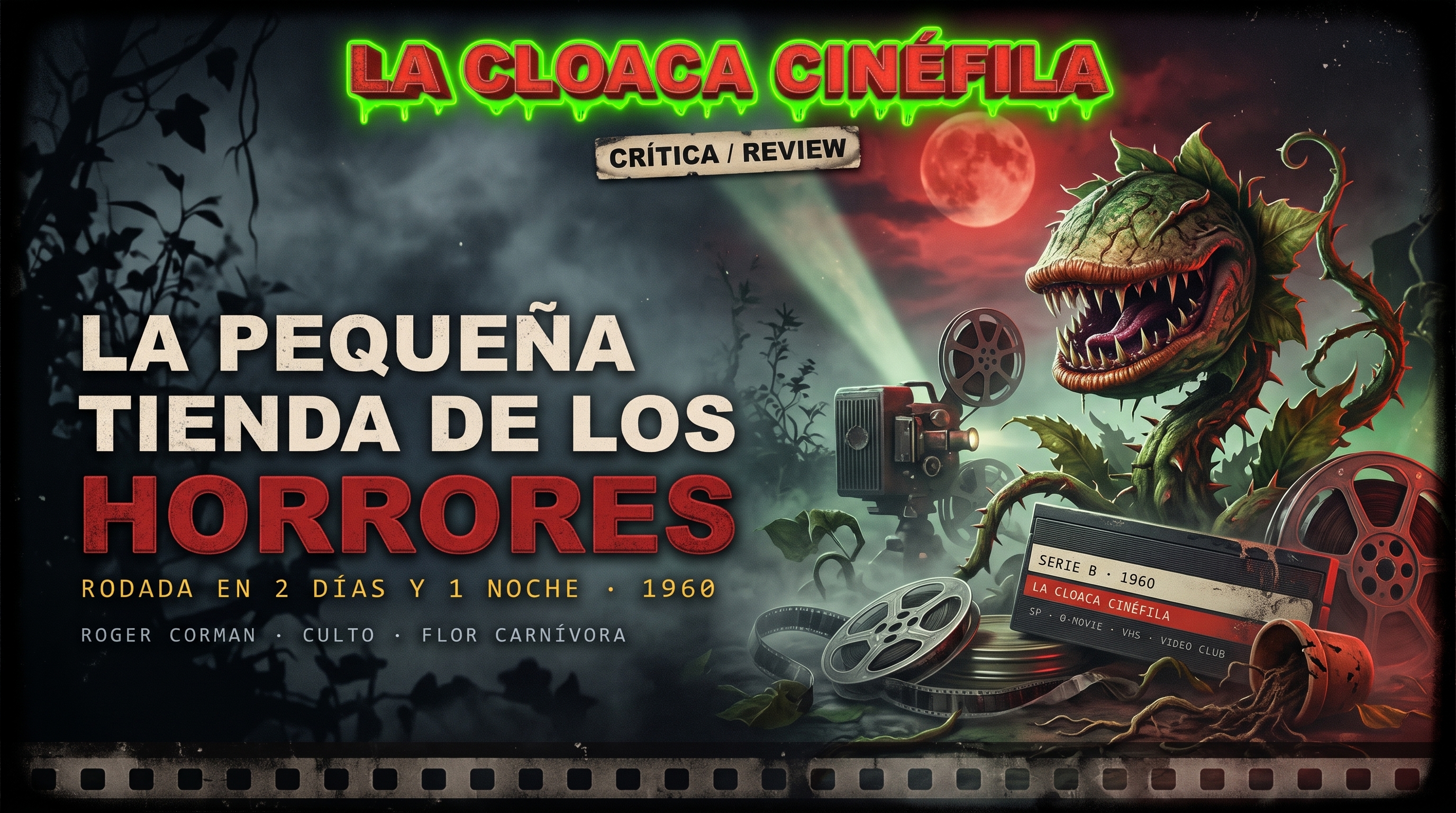
The Little Shop of Horrors: Corman Shot His Man-Eating Plant in Two Days
Roger Corman shot this 1960 classic in two days and one night for around $30,000. The most famous man-eating plant in B-movies, in 72 minutes.
Contents
Video store review | La Cloaca Cinephile
Two days of shooting, one extra night and a flower that demanded blood. The classic with which Roger Corman proved that budget is just an excuse.
Fast facts
- Title: The Little Shop of Horrors
- Year: 1960
- Director: Roger Corman
- Screenplay: Charles B. Griffith
- Genres: Black comedy, horror, B-movie
- Cast: Jonathan Haze, Jackie Joseph, Mel Welles, Dick Miller, Myrtle Vail, Leola Wendorff and Jack Nicholson
- Runtime: 72 minutes
- Where to watch it in Spain: Filmin and Cultpix by subscription; free with ads on Plex, Filmzie, Runtime and JustWatch TV Free; rental on Bloodstream for €2.73
- Heads-up: black humour from another era, a sadistic dentist and a plant with a very short fuse.
Images and visual material: JustWatch Spain page
Seymour, the Flower and the Dentist
Seymour Krelboyne is the clumsiest employee at Gravis Mushnick’s flower shop, a man who shouts more than he pays. Seymour is silently in love with Audrey, the other clerk, and to impress her he has grown a strange plant in the basement: a kind of carnivorous flower he has named Audrey Jr. The problem is that the plant does not eat fertiliser. The plant wants blood.
What starts as a botanical pet becomes a business, then a secret and finally a problem with dead bodies. Along the way we meet a masochistic dentist, a customer buying flowers for a wake and a very grumpy patient played by a certain Jack Nicholson. The film has not a single wasted minute: 72 minutes cover crime, office comedy, impossible romance and a plant that grows at the speed of capitalism.
Two Days, One Night and a Real Corpse
The legend of this film is so well known that it almost buries the film itself: Roger Corman shot it in two days and one night. The backstory is even better. Corman had the sets of A Bucket of Blood standing and about to be struck, so he decided to use them. Three days of rehearsal, two days of interior shooting and one extra night to finish what was left. The exteriors were shot by Charles B. Griffith — the film’s screenwriter — over two weekends, with $279 of rented equipment and a total budget of $1,100 for some fifteen minutes of footage.
The result is hard to believe. The budget has traditionally been put at between $28,000 and $34,000, with Corman himself saying around $30,000. On that money the team allowed itself luxuries that are now anecdotes: they convinced a funeral home to lend a hearse with a real corpse inside, rented a rail yard for two bottles of whisky and paid children five cents each to run out of a subway tunnel. They also hired several homeless men as extras for ten cents, and some ended up working as improvised crew.
The shot of the train running over an actor is a textbook trick: there was no money for effects, so the locomotive was reversed and the shot printed backwards. Corman shot with three cameras in wide masters and a single take per scene, no coverage. If something went wrong, it stayed wrong. That guerrilla economy is exactly what gives the film its cartoon rhythm.
Why 72 Minutes Still Work
The Little Shop of Horrors works because it does not take itself seriously and yet it is well built. Charles B. Griffith’s script is a gag machine: the dentist who enjoys pain, the hypochondriac customer, the useless cop, Seymour’s mother going on about her legs. Every character is a walking joke, and all of them orbit the same idea: the plant is not a monster, it is a business.
That is the reading the film allows and the one that makes it smarter than it looks. Audrey Jr. does not attack out of malice: she asks to be fed, she grows and she generates income. Seymour feeds her because the flower finally gives him the recognition life denies him. The flower shop, that family business surviving as best it can, becomes a metaphor for bottomless consumption: the more the plant grows, the bigger the problem and the better the business. It is no accident that the 1982 musical turned that basement into a Broadway stage.
On top of that, the film has a luxury cast for what it cost. Jonathan Haze builds Seymour out of tenderness and disaster, Jackie Joseph gives Audrey a flawless B-movie sweetness and Mel Welles eats the screen as the shouting florist. Dick Miller, Corman’s regular, is enormous as the customer who eats the flowers. And yes, Jack Nicholson appears briefly, but his scene with the dentist is one of the most quoted of his early career.
From Skid Row to a Broadway Musical
The film began as a cheap assignment and ended up as a cultural franchise. In 1982, Howard Ashman and Alan Menken turned it into an off-Broadway musical that became legendary; 1986 brought the film adaptation with Rick Moranis, Ellen Greene and Steve Martin as a psychopathic dentist; in 2003 the musical returned to Broadway with a new production. Few films shot in two days can boast of having spawned a plant that sings.
It also helps that the film has circulated in the public domain in the United States for decades, which explains why it appears on so many free platforms in copies of uneven quality. That is part of its video store charm: the film is watched the way it has always been watched, on a TV that is not the best in the living room and with someone shouting from the kitchen.
The Little Shop of Horrors Trivia
- The corpse was real: the funeral home lent a hearse with a body inside for one scene. Corman always told the story with a grin.
- Five cents to run: the children running out of the subway tunnel were paid a nickel each.
- Whisky as rent: the rail yard was secured for two bottles of Scotch.
- The train went backwards: the train shot was filmed by reversing the locomotive and printed in reverse.
- Three cameras, one take: Corman shot wide masters with three cameras and never repeated. What we see is almost live.
- Nicholson, patient: his character is called Wilbur Force and walks into the dentist’s office with a historic toothache.
- Corman did not shoot the exteriors: Charles B. Griffith directed the two weekends of exteriors, something Corman himself acknowledged.
La Cloaca’s Verdict
The best
- The pace: 72 minutes with no fat and a gag every other scene.
- The mix of office comedy and basement horror, a formula still being copied today.
- Mel Welles and Dick Miller, two supporting actors who steal the show.
The worst
- The humour is from 1960: some jokes about the dentist or the customers have aged poorly.
- The copy you find depends on the platform; some free versions look pretty rough.
For fans of: Roger Corman’s cinema, low-budget horror comedies, the Ashman and Menken musicals and films that prove two days can be enough.
Rating: 4 out of 5. It is not Corman’s best film, but it is one of his most influential, and watching it is the fastest way to understand why B-movies never needed permission.
Where to Watch The Little Shop of Horrors in Spain
The film is available in the Spanish catalogue right now through several routes, almost all cheap or free:
- Filmin: included with the subscription.
- Cultpix: included with the genre streaming service.
- Bloodstream and Artiflix: available by subscription (Bloodstream also offers rental for €2.73).
- Free with ads: Plex, Filmzie, Runtime and JustWatch TV Free.
- Digital rental: €2.73 on Bloodstream.
Note: streaming availability in Spain can rotate over time. We recommend checking the updated catalog on JustWatch Spain.
References and visual links
- The Little Shop of Horrors on JustWatch Spain - up-to-date availability
- IMDb page - cast and technical details
- The Little Shop of Horrors on Wikipedia - production figures and shooting anecdotes
- If you want to meet the man behind the plant: Roger Corman: the biography of the king of B-movies
- More B-movies: Silent Night, Deadly Night: the Santa Claus that terrorised America and B-Movie Releases (Nov 20–29)
Verdict
Sewer score out of 5
More from the sewer

B-Movie Releases (Nov 28–Dec 6): Arachnids, Santa and Cardboard Glory
Crawlers, Violent Night 2, Madoka and a cheap Christmas back catalogue: Spain's B-movie week, November 28 to December 6, 2026.
14 min
Roger Corman: the Biography of the King of B-Movies
From the Fox mailroom to New World Pictures: the life of Roger Corman, who shot films for less than a used car and trained Coppola and Scorsese.
9 min

B-Movie Releases (Nov 20–29): Killer Santa, Gummies and Video Store Gold
Silent Night, Deadly Night, Gummy, Sanguine and Just Play Dead: Spain's B-movie week, November 20–29, 2026.
16 min