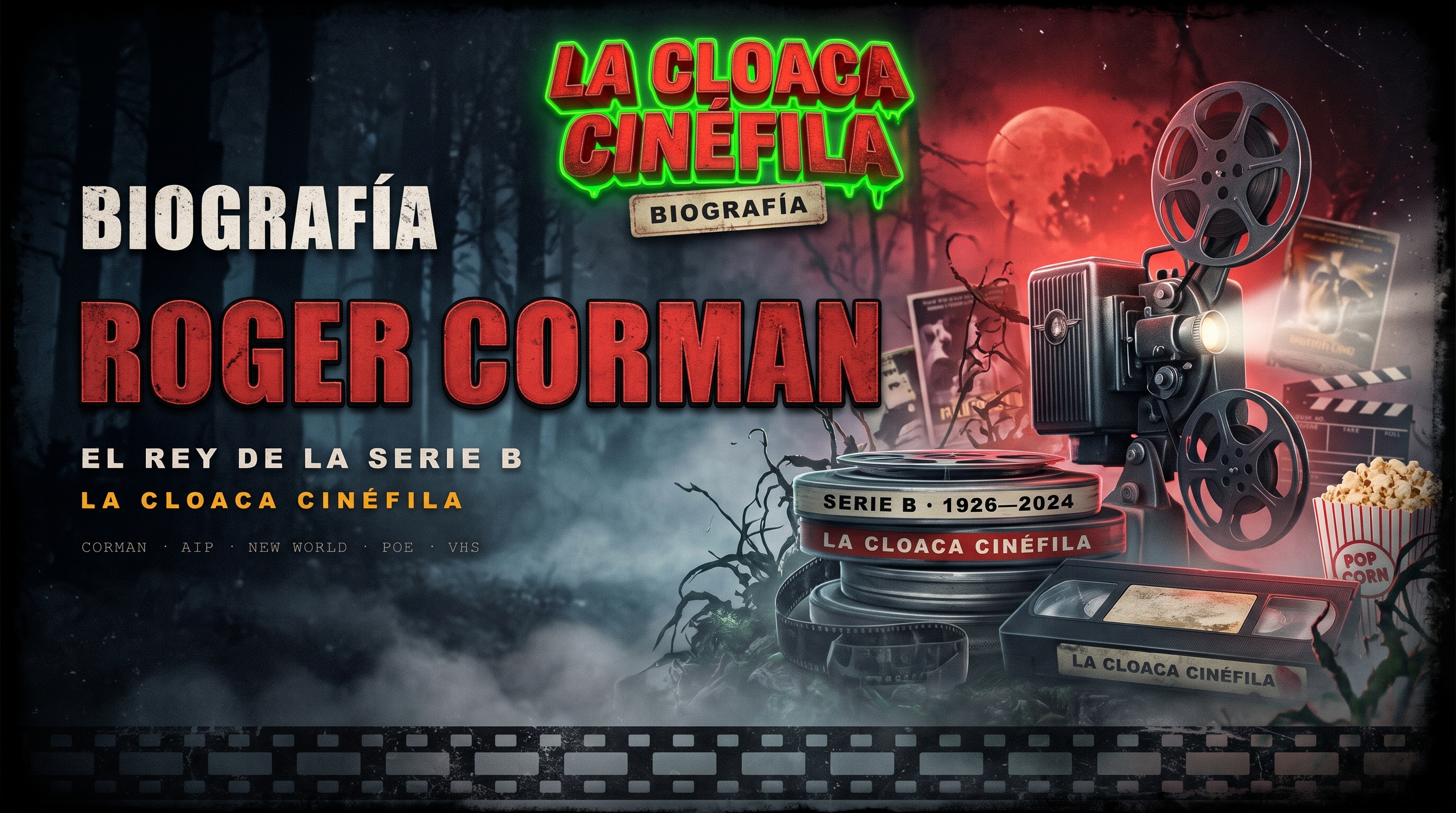
Roger Corman: the Biography of the King of B-Movies
From the Fox mailroom to New World Pictures: the life of Roger Corman, who shot films for less than a used car and trained Coppola and Scorsese.
Contents
Video-store biography | La Cloaca Cinephile
Five hundred films, pocket-money budgets and a school of directors that ended up conquering Hollywood. Who was the man who turned scarcity into a style.
Quick Facts
- Name: Roger William Corman
- Born: April 5, 1926, Detroit, Michigan (USA)
- Died: May 9, 2024, Santa Monica, California (aged 98)
- Roles: director, producer and screenwriter
- Companies: The Filmgroup, New World Pictures, New Horizons and Concorde
- Nicknames: ‘The Pope of Pop Cinema’, ‘The King of Cult’, ‘The Spiritual Godfather of the New Hollywood’
- Number: more than 500 features directed or produced
- Award: Academy Honorary Award (2009)
- Where to watch his films in Spain: Filmin, Prime Video, Acontra+ and free-with-ads options (details below)
An Engineer Who Loathed Engineering
Roger Corman grew up in Beverly Hills —yes, in the same town that dreamed of the studio next door— studied industrial engineering at Stanford, joined the Navy during World War II (1944–1946) and returned to Stanford to finish his degree in 1947. He lasted four days as an engineer at U.S. Electrical Motors: he started on a Monday and by Thursday he was telling his boss he had made a terrible mistake.
Then came the mailroom at 20th Century Fox, for $32.50 a week, and the job of story reader. When one of his ideas was filmed as The Gunfighter (1950), with Gregory Peck, and he got no credit at all, Corman quit and decided that if he was going to work in film, it would be on his own. Under the GI Bill he studied English literature at Oxford, lived for a time in Paris and returned to Los Angeles to find a way in.
The Mailroom as a Film School
In 1954 he sold a script called Highway Dragnet for $2,000 and, with that money plus contacts, raised $12,000 to produce his first feature, the science-fiction Monster from the Ocean Floor. The next one, The Fast and the Furious, he sold to a young outfit called American Releasing Company, run by James Nicholson and Samuel Z. Arkoff —later American International Pictures, AIP—. In exchange for an advance that let him make two more films, Corman sat down at the head of the American B-movie table.
His first film as director, Five Guns West (1955), cost around $60,000. From then on the formula never changed: shoots measured in days, not weeks; a stock company of reliable character actors; fast screenwriters (Charles B. Griffith, Richard Matheson, Robert Towne); and one eye fixed on what drive-in audiences wanted. In 1959 he founded The Filmgroup with his brother Gene and kept producing black-and-white double features for the drive-in circuit.
The Corman Formula
The leap came in 1960. AIP wanted two black-and-white horrors for under $100,000 each; Corman countered with an unthinkable proposal: colour, $200,000, fifteen shooting days and an Edgar Allan Poe adaptation, The Fall of the House of Usher, scripted by Matheson and starring Vincent Price. It was a critical and commercial hit and opened what became known as the ‘Poe cycle’: eight films with Price that remain the summit of his directing career.
The other side of the coin is The Little Shop of Horrors (1960), shot —legend says so, and the legend is right— in two days and one night. The Intruder (1962), with William Shatner, attacked racism in the American South and became his biggest failure: it took ages to be released and never earned back its cost. Corman never hid the contradiction: he shot fast and cheap, but when he set out to say something, he said it.
In 1964 he was the youngest filmmaker to get a retrospective at the Cinémathèque française —also at the BFI and MoMA—. Soon after he tried the major studios, made the first biker movie in history, The Wild Angels (1966), which opened the Venice Film Festival and grossed more than $6 million on a $350,000 budget, and directed The Trip (1967) from a script by Jack Nicholson. In 1970 he left AIP after 33 pictures because they had re-edited four of them without telling him.
The Directors’ Workshop
This is where Corman stops being just a cheap producer and becomes the most important man in his own legend. His method: the kids who cut his trailers and his trailers got a whole film to ruin on their own.
- Francis Ford Coppola: Corman financed his debut, Dementia 13 (1963).
- Martin Scorsese: Boxcar Bertha (1972), his second feature.
- Peter Bogdanovich: Targets (1968), built with recycled footage from The Terror.
- Jonathan Demme: Caged Heat (1974), his debut.
- Joe Dante and Alan Arkush: they cut trailers; Corman gave them Hollywood Boulevard (1976), then Piranha (1978) and Rock ‘n’ Roll High School (1979) each on their own.
- Ron Howard: Grand Theft Auto (1977), his first feature.
- John Sayles: discovered as a story reader; he wrote Piranha.
- James Cameron: started out building models and effects for Battle Beyond the Stars.
In front of the camera came people like Jack Nicholson —his first leading role was in The Cry Baby Killer (1958), produced by Corman—, Peter Fonda, Dennis Hopper, Bruce Dern, Diane Ladd and William Shatner. If the New Hollywood has a surname, that surname is Corman, even when the credits say otherwise.
New World: The Independent That Distributed Bergman
In May 1970 he founded New World Pictures, an independent company that made $3.2 million in its first year. There he perfected the cycle business —nurses, biker girls, women in prison— but also did something unexpected: when the major studios abandoned foreign cinema, New World took over the US distribution of Bergman’s Cries and Whispers (bought for $75,000, it grossed over $2 million) and brought the work of Fellini, Truffaut, Kurosawa and Schlöndorff to grindhouse audiences. One catalogue held both Amarcord and Death Race 2000.
Death Race 2000 (1975), directed by Paul Bartel and produced by Corman, earned $4 million and spawned a wave of car movies. In January 1983 Corman sold New World for $16.9 million and kept making films through New Horizons and Concorde: Carnosaur, the direct-to-video Death Race sequels, Syfy creatures and even a Fantastic Four (1994) made solely to hold on to the rights, never officially released.
Roger Corman Curiosities
- Two days and one night: that is how The Little Shop of Horrors was shot, with the same cast and structure as A Bucket of Blood.
- Betting against AIP: instead of two black-and-white horrors for under $100,000, he offered colour and $200,000. The Fall of the House of Usher proved him right.
- The late Oscar: in 2009 the Academy gave him an honorary award ‘for his films and for the filmmakers he engendered’.
- A precocious retrospective: in 1964, aged 38, he was the youngest filmmaker with a retrospective at the Cinémathèque française.
- He quit AIP angry: after four consecutive re-edits without his consent —the most brutal being Gas-s-s-s (1970)— he left the company he had fed for 33 pictures.
- Also an actor: he turns up in The Godfather Part II, The Silence of the Lambs, Philadelphia and Apollo 13, mostly in cameos in his disciples’ films.
- The book: he wrote his memoir, How I Made a Hundred Movies in Hollywood and Never Lost a Dime.
The Sewer’s Verdict
The good
- His method: scarcity as the screenplay, not the excuse. Nobody has ever compressed so much cinema into so little money.
- The school: no Corman means no New Hollywood, and no B-movies means no video store.
- The filmography: from Poe to bikers, from gummy-addicted serial killers to sharks with fins.
The bad
- The catalogue is unequal by design: for every The Masque of the Red Death there are three Syfy creatures that only ask to be forgotten.
- Some products from his later years put the commission above the idea.
For fans of: drive-in cinema, impossible budgets, credits where the genies are not genies yet, and any film that opened with ‘from Roger Corman’.
Rating: 5 out of 5 for the character. The filmography, like the man himself, is to be handled with tweezers and with affection.
Where to Watch Roger Corman’s Films in Spain
Checked on November 17, 2026 against JustWatch Spain:
- Filmin (subscription): The Little Shop of Horrors (1960), The Masque of the Red Death (1964) and Piranha (1978).
- Prime Video (subscription): The Raven (1963) and Death Race 2000 (1975, produced by Corman).
- Acontra+ (subscription): Rock ‘n’ Roll High School (1979, produced by Corman); rental at €1.99.
- Free with ads: The Little Shop of Horrors on Plex and Runtime; Rock ‘n’ Roll High School on Plex.
- Rental and purchase: The Raven from €2.99 on Amazon Video; Piranha from €2.99 on Amazon Video and €3.99 on Apple TV.
- No options: the documentary Roger Corman: Hollywood’s Wild Angel (1978) is not available for streaming in Spain.
Note: Streaming availability in Spain rotates regularly. We recommend checking real-time listings on JustWatch Spain.
References & Visual Links
- Roger Corman on JustWatch Spain - updated availability
- The Little Shop of Horrors on JustWatch Spain - the one he shot in two days
- The Masque of the Red Death on JustWatch Spain - the peak of the Poe cycle
- The Raven on JustWatch Spain - Poe with a grin
- Death Race 2000 on JustWatch Spain - Bartel directs, Corman produces
- Piranha on JustWatch Spain - Joe Dante at the wheel
- Rock ‘n’ Roll High School on JustWatch Spain - the Ramones and Corman
- Roger Corman on Wikipedia - biographical data and complete filmography
- If you like low budgets with dignity: Troll 2: the best worst movie ever made and Demons on the Highway: 7 B-Movie Road Trips You Shouldn’t Take
- And this week’s programme: B-Movie Releases (Nov 20–29): Killer Santa, Gummies and Video Store Gold
More from the sewer

B-Movie Releases (Nov 28–Dec 6): Arachnids, Santa and Cardboard Glory
Crawlers, Violent Night 2, Madoka and a cheap Christmas back catalogue: Spain's B-movie week, November 28 to December 6, 2026.
14 min
 4/5
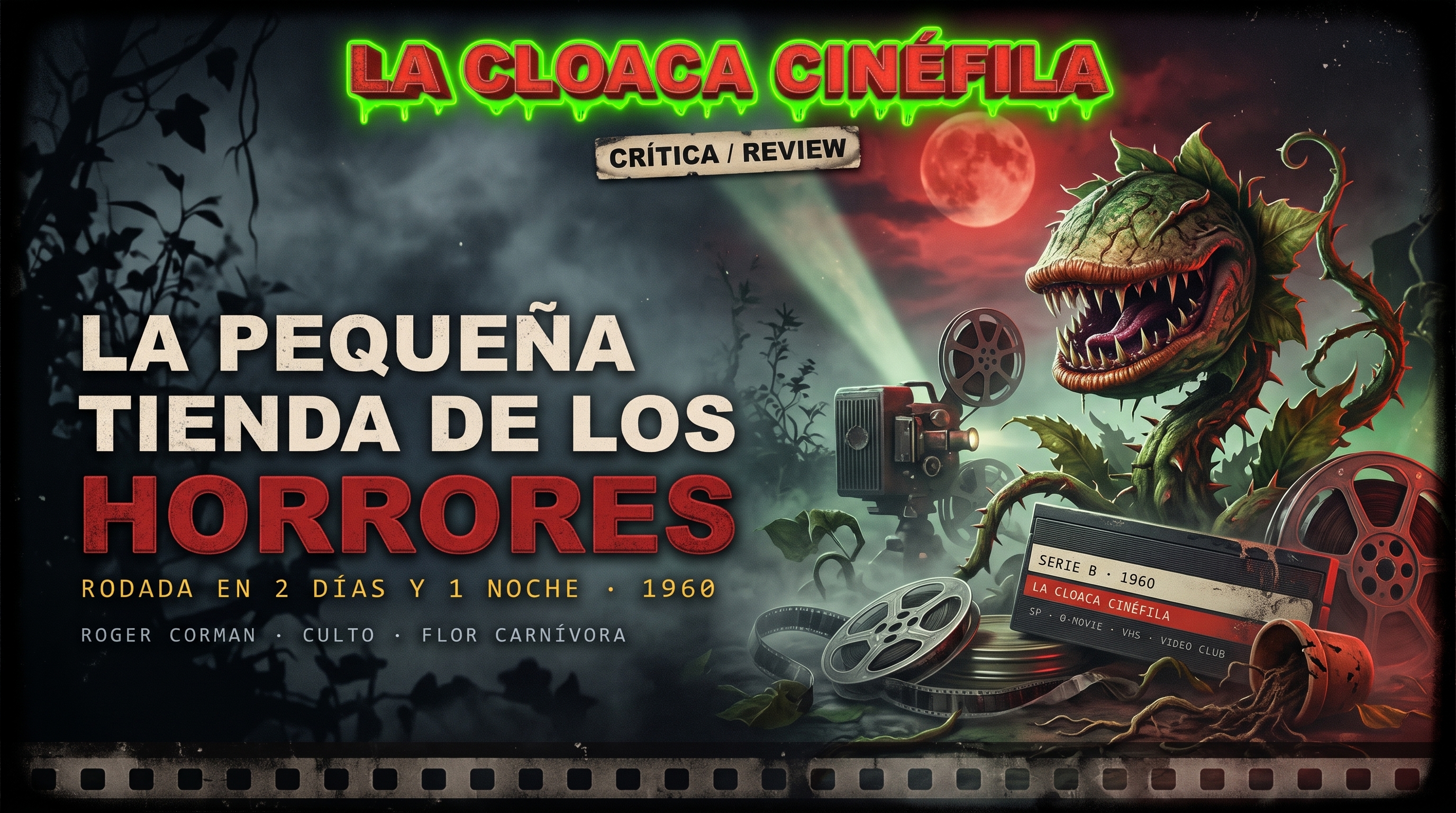
The Little Shop of Horrors: Corman Shot His Man-Eating Plant in Two Days
Roger Corman shot this 1960 classic in two days and one night for around $30,000. The most famous man-eating plant in B-movies, in 72 minutes.
7 min

B-Movie Releases (Nov 20–29): Killer Santa, Gummies and Video Store Gold
Silent Night, Deadly Night, Gummy, Sanguine and Just Play Dead: Spain's B-movie week, November 20–29, 2026.
16 min